To get your business in front of a broad international audience, you first need to decide between website builder vs WordPress for your website. A website builder is affordable, straightforward, and requires close to zero technical knowledge. WordPress is a touch more complex, but it also opens up your website to more possibilities.
Let’s take a close look at website builder vs WordPress as two solid options for Kenyan entrepreneurs, eCommerce sellers or artists looking to build an online presence. We’ll go over total costs involved in the launch and maintenance, ease of use, scaling potential and capabilities, localization options, and much more. At the end, you’ll be able to make a confident decision that will drive your digital business growth.
WordPress vs Website Builders: Main Takeaways for Kenyan Users
To get a clear shared foundation for further analysis, let’s first outline the core features and functionalities of website builders and WordPress.
What Are Website Builders?
Website builders are tools that offer design templates and drag-and-drop builders with pre-defined website logic to guide the website creation process. Basically, they are your bread and butter to launch a website fast, easily, and independently. That means even a novice Kenyan entrepreneur with no technical experience can get their eCommerce website, creative portfolio, or digital startup platform live in days.
The setup and maintenance costs for website builders typically fit into KES 600-3,000 monthly budget that already includes web hosting, SSL certification, and even eCommerce functionality. Most website builders have vast knowledge bases and superstar live support that doesn’t just solve problems, but also consults on the website creation process.
What Is WordPress (And How is It Different)?
WordPress is a world-famous free content management system (CMS) and website building platform. In simple terms, it’s a space that allows you to launch and scale your website on your own terms - you choose the complexity, costs, and functionalities of your website.
WordPress comes in two versions. WordPress.com is a hosted solution, meaning less hassle but also fewer options for customization. It’s mostly used by bloggers or content creators who need a basic, affordable platform to get their content out there.
WordPress.org, on the other hand, is a powerhouse for content management and website creation and it’s the version we will be analysing in this article. WordPress.org main building blocks are themes and plugins that enable you to shape the website to your imagination. WordPress.org is self-hosted, meaning you will have to choose your own WordPress hosting solution for the website, but it’s not a complicated process. Plus, Kenyan entrepreneurs can benefit from local hosting providers like HostAfrica that offer one-click installation for WordPress from their panel.
The only real downside of WordPress is the maintenance demand. Core, plugin, and theme updates need to be carried out individually, regularly and immediate support might not always be available.
As for the costs, WordPress itself is free, but most themes and plugins have paid premium plans if you want full feature access and premium support and the prices vary quite drastically.
Comparing WordPress and Website Builders for Kenyan Businesses
To make an informed decision when choosing between a website builder and WordPress, we need to analyse the learning curve involved in launching and maintaining your site, design capabilities, localization options for payment methods, SEO possibilities and more.
1. Setup Speed and Learning Curve
Website builders shine with simplicity. Any Kenyan entrepreneur can launch a site in days if not hours depending on what functionalities that site requires. The builder interface and templates of most website builders have been honed for years so the setup and launch process is intuitive.
Another advantage of website builders is that AI tools are almost always present and are advanced enough to assist you even with content creation, for example product descriptions. And if you’re struggling, most reputable website builder platforms like HostAfrica or Wix have guided onboarding processes and local agencies that provide live support.
In contrast, WordPress has a much steeper learning curve. Users need to buy hosting, install WordPress, choose a theme, then research, install and manage plugins. Even though theoretically it’s not that complicated, practically it can seem quite daunting to prepare for and execute.
However, if there is one thing WordPress has, it’s community. User-led learning resources, including the main WordPress.org support forum, YouTube tutorials, Kenyan tech blogs, and online courses, are numerous and informative, so whatever issue you have, you will eventually find an answer.
In short, website builders trump WordPress in regards to simplicity and accessibility for non-technical users.
2. Design Freedom and Brand Identity
Website builders come with pre-defined design templates, which can be both a blessing and a curse. On one hand, you just need to pick one that fits your business model, adapt to your brand assets, then simply paste text and upload images into ready-made fields. Plus, if you dabble in code at all, most website builders enable your imagination with custom CSS or custom code integrations.
But what happens when you truly need to think outside of the box?
In the rare cases where you require especially unique layouts or design features, website builders present limitations. That being said, such website design choices need to be perfectly justified, because anything out of the ordinary can cause issues with responsive design, usability, site speed and scalability.
Another downside of website builder design templates is that everyone has access to them. That doesn’t necessarily mean your website will be identical to that of other creators or business managers in Kenya, but it does mean you will have to be innovative with template customization.
Conversely, the design capabilities when working with WordPress are completely limitless. Free, paid or even custom-made WordPress themes are your visual foundation, and it’s up to you where you go from there. Visual page builders like Elementor typically provide more design flexibility than website builders, plus you can easily find Kenyan web development agencies, such as Webpinn, that will custom-design and code certain website sections.
The final verdict on this end is not clear cut. While typically WordPress setup provides you with more flexibility, the vast majority of design and branding ideas can be executed just as well using a website builder.
3. eCommerce Features and Local Payment Integration
As a small business owner or local artist, your biggest priority should be your buyers. To make their experience smooth, local Kenyan payment methods and currencies need to be available and function smoothly.
Website builders are trying hard to stay competitive in the eCommerce area and they’re doing so quite successfully. Local payment methods like M-Pesa can be integrated in most website builders, albeit usually using third party tools. Most website builders localized to the Kenyan market, like HostAfrica or Host Pinnacle, support Kenyan shillings as your website currency too.
However, WordPress plus WooCommerce is a match made in heaven for any local sellers. WooCommerce is the most widely used eCommerce plugin by miles, so it has a solid range of supporting plugins, including one for direct M-Pesa integration. This goes to show that with WordPress, you can build an eCommerce infrastructure that is tailored exactly to your buyers’ needs and preferences.
So, while website builders do the job and let you build a functioning eCommerce site for Kenyan buyers, WordPress plus WooCommerce gives you 100% confidence that all eCommerce features and payment getaways will be exactly as you need them.
4. SEO and Visibility in Kenyan Search Results
Website builders have a set of basic SEO tools and features - usually sufficient to launch a functioning and search optimized blog or small product catalog. Typically, this is what you can expect from SEO features in a website builder:
- Custom URL editing
- Meta title and descriptions
- Image alt text
- Basic redirect functionalities
Website builders also pay great attention to site responsiveness and mobile experience as well as site speed. As long as you don’t break the layout with custom code integrations or don’t upload 2MB images, your website should be fast and responsive on all devices.
However, eCommerce websites with broad product selections, real estate catalogs, or news websites can find the lack of advanced functionalities, like structured data markup, indexing or canonical tag control or native video optimization features, quite limiting.
WordPress, on the other hand, once again offers unmatched capabilities and potential for SEO and organic growth. Benefit from world-class SEO plugins like Rank Math or Yoast SEO that have pre-defined fields for all basic SEO functionalities as well as advanced features managed through a separate dashboard section. For local businesses, like coffee shops or clothing stores, WordPress features local SEO optimization plugins that will help your website rank in your Kenyan neighbourhood or area.
As a whole, WordPress is far superior to website builders for advanced SEO optimization. However, website builders ensure the basic requirements are met and your website is technically sound and search-ready.
5. Hosting, Speed & Performance in Kenya
Website builders bundle hosting into their service, so fast and reliable performance without much setup is guaranteed. However, they host globally, which might affect site speed in Kenya depending on internet conditions. Your best choice are local website builders like HostAfrica that offer Africa-based servers and guarantee 99.9% uptime.
Another aspect to consider is server-level optimizations, which are usually limited on website builders. While for most online businesses or catalogs that doesn’t present a big issue, sites with high traffic spikes or heavy multimedia content might suffer performance issues with lower-tier website builder plans.
With WordPress, performance depends on your hosting provider and optimization plugins. Choosing a local host like HostAfrica or Host Pinnacle ensures faster loading times and better customer support, especially when targeting local audiences.
The bottom line is - if you choose a website builder that focuses on the Kenyan market, you can rest assured your site will load fast and perform well on the search.
6. Maintenance, Security & Backups
As a Kenyan entrepreneur, naturally you’re concerned about your website's maintenance costs, complexity, and resources needed. Website builders are your go to option here - they are as hands off with maintenance as it gets.
Website builders inherently handle everything: SSL certificates and renewals, automatic backups, DDoS protection, server maintenance and routine platform updates. Basically the only thing you need to do is ensure your business details, website content and media are up to date.
If you decide to go with a self-hosted WordPress site, most of these responsibilities will lie on your shoulders. A good hosting provider will take care of SSL certifications, basic firewalls, integrated malware scanning tools, and automatic website backups, but that’s about it.
Plus, WordPress plugins and themes are notorious for being a security risk on their own. If you fail to routinely update your plugins and themes and patch up security vulnerabilities, you expose yourself to a bouquet of potential malicious activities, such as cross-site scripting, database injections, or even brute-force attacks to gain access to your website’s data.
Already tired of listening to all this cybersecurity jargon? Do yourself a favor, eliminate any and all headaches related to website technical maintenance and security and choose a reliable website builder.
Website Builder and WordPress Pricing in Kenya: Which One Offers More Value for Money?
WordPress lures a lot of entrepreneurs in with a promise of free, all-powerful, open-source content management system, but depending on the scope of your project, the final WordPress cost in Kenya can rack up quite a bill.
Website builders ensure you know your fees upfront and exactly. Website builder prices in Kenya are usually composed of three or four tiers with clearly outlined features and functionalities. Whenever you settle on your preferred option, that’s what you’ll be paying monthly unless you wish to upgrade along the way.
But what does that mean if we were to discuss actual numbers? Let’s take a look:
| Platform | Initial setup | Monthly costs | Yearly Hosting | Additional Costs |
| Website builder | Up to KES 3,000 | KES 700-2,500 | Included | Minimal, premium add-ons or templates |
| WordPress | KES 1,000-3,000 (domain and hosting) | KES 300-800 | KES 3,500-10,000 | Vary drastically, premium plugins/templates, dev assistance |
Cost Breakdown for Different Website Types
Since the capabilities of both website builders and WordPress are broad, price breakdowns tend to be vague and confusing. To give you a clear idea, let’s consider a couple of realistic cases.
Example 1: Small eCommerce Website
- Website type: eCommerce website with 30 products in its catalog targeting local Kenyan audience
- Payment gateways needed: mandatory M-Pesa integration
- Security features: extra security layer to protect customer credit card details
- SEO features: structured data markup for products and other advanced features needed
- Other needs: n/a
Estimated yearly budget with website builder: KES 8,400-36,000
Estimated monthly budget with WordPress: KES 40,000-60,000
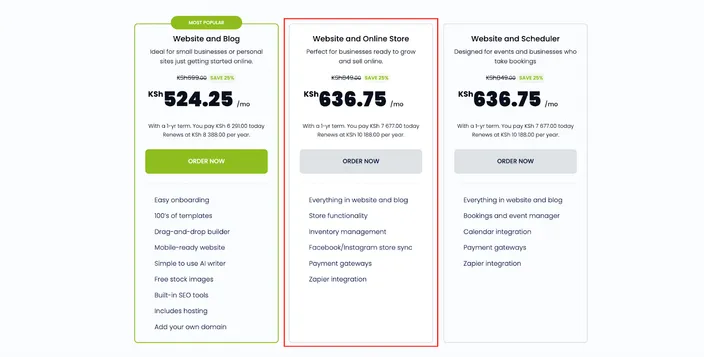
For this type of website, you will need to look into website builder plans that support online stores. Some, such as HostAfrica, start as low as KSh 849/mo, but you’ll definitely find pricier alternatives too. Unless you want to add paid advanced features, that’s the cost you’re looking at.
When building an online store with Wordpress, your costs add up: web hosting, domain name, premium M-Pesa integration, SEO, security plugins are the bare necessities. But for a more powerful eCommerce structure, you might want an upgraded page builder version, email marketing and cart abandonment management plugins and more.
Typically, managing an average size eCommerce site will be at least twice more expensive on WordPress if compared to a website builder.
Example 2: Website for a Small Local Business with Physical Location
- Website type: website for a spa located in Westlands, Nairobi. The site will showcase services, staff profiles, and offer online appointment booking for individual or group sessions
- Payment gateways needed: not needed
- Security features: SSL certificate (comes with hosting)
- SEO features: structured data markup for services, local business schema, Google Maps embedding, and advanced on-page SEO
- Other needs: SMS/email reminders and staff/service-specific booking options.
Estimated yearly budget with website builder: KES 8,400–36,000
Estimated monthly budget with WordPress: KES 32,000–55,000
For a website with appointment scheduling and service descriptions at the center, you will need website builder plans with built-in appointment scheduling tools. These website builder plans usually fall into the same or lower pricing category as online store plans, in the case of HostAfrica it’s the exact same monthly fee of KSh 849/month.
For WordPress, besides the usual suspects like web hosting services and security plugin, you will need plugins with calendar and booking functions, push notifications and more. That again adds up to quite significant costs, albeit not as high as eCommerce stores.
Example 3: Visual Artist Portfolio Website
- Website type: portfolio website for a visual artist. The site will showcase artwork galleries, artist bio, exhibition history, and a contact form for commissions or collaborations
- Payment gateways needed: not needed
- Security features: SSL certificate and additional security to protect image files and client communications through contact forms.
- SEO features: basic tools focused on WordPress image optimization
- Other needs: n/a
Estimated yearly budget with website builder: KES 7,200–25,000
Estimated monthly budget with WordPress: KES 10,000–30,000
For artist portfolios or other websites that simply require landing pages, the costs will be relatively minimal on both website builders and WordPress. Lowest tier website builder plans start at around KSh 699/mo, but you need to make sure it will be sufficient for the size of your media library.
As for your WordPress setup, you can get away with free versions of pretty much any theme or plugin you need as long as you’re not trying to sell your art on the website. In that case, your costs would mainly include hosting and domain name.
Real-World Scenarios: Which One Should You Choose in Kenya?
Now let’s consider another angle - how do you choose between website builder and WordPress based on your unique needs and scenarios? We have prepared a quick breakdown that we hope will point you in the right direction.
Go With a Website Builder If You...
Website builders are perfect for those who want speed, simplicity, and peace of mind. Here’s when a builder might be the right choice:
- Need to launch fast (e.g., campaign microsite, artist portfolio): you can have a functional and attractive site up and running in a few hours, no need for setup or integration.
- Have no tech background: everything is handled behind the scenes, from hosting and security to design and analytics, you just need to drag elements and enjoy results.
- Want all-in-one pricing and minimal maintenance: pay a single monthly or annual fee that includes everything and update the site only when your business information changes.
- Are testing a business idea before scaling: builders are excellent for MVPs (Minimum Viable Products) or temporary projects like event pages.
- Operate a local service with basic online needs: if your salon in Nairobi or hardware store in Kisumu just needs a few pages with contact info, hours, and a photo gallery, website builder is the way to go.
Choose WordPress If You...
WordPress is ideal for people who need flexibility, growth potential, powerful features, and aren’t afraid to get their hands dirty. Go for WordPress when you:
- Are building a blog, news site, or content-heavy project: WordPress was built explicitly for content management. You can organize categories, tags, authors, and more with precision.
- Plan to scale with more features (e.g., classifieds, real estate listings): add advanced functionality through thousands of free and paid plugins.
- Want monetization options (ads, memberships, affiliate tools): WordPress lets you integrate platforms like Google AdSense, affiliate links, and membership plugins like MemberPress.
- Need deep customization: every part of your site is up for discussion, there is a plugin literally for everything. Research and install them, just make sure they don’t clash with each other and are well supported.
- Run an eCommerce platform with local integrations: WooCommerce offers powerful features and supports Kenyan payment methods like M-Pesa and PesaPal.
- Need multilingual support and localization: easily translate your site to and from Swahili and other languages using plugins like WPML or Polylang.
- Want to fully own your website and data: with WordPress, you host your site and control your files, backups, and databases.
- Have long-term growth in mind: if your site is a key part of your business strategy, the flexibility and scalability of WordPress will pay off over time. And if it ever gets too much, you can find a qualified WordPress developer in minutes.
How WordPress Has Evolved: What You Can Now Do Without a Developer
WordPress is powerful, but can I use WordPress without coding in Kenya? Or can I only unlock its full potential with the help of professional developers?
WordPress page builders, themes, plugins, and other site building frameworks have evolved to the point that you can successfully launch and run a WordPress site with zero coding knowledge or involvement from a developer.
That doesn’t mean it’s extremely simple though. The learning curve for WordPress if compared to a website builder is still much steeper. You have to know very well what you need to achieve with your site and do a lot of research about the best WordPress plugins and templates necessary to get there. As of 2025, over 60,000 free WordPress plugins are available, so choosing the right ones and knowing how they interact with each other is no small task.
That being said, don’t let it intimidate you! If you’re up for the challenge, you can single-handedly launch a WordPress site that you will fully own and manage yourself.
In Conclusion: Choosing the Right Tool for Your Online Website
At this point, we carried out the website builder vs WordPress debate from several angles and the main takeaway should be this: if you're a Kenyan entrepreneur in accountancy, IT, fashion or any other industry, looking to launch a basic site fast and affordably, a website builder is a great starting point.
But if you’re serious about scaling, need advanced features, or want complete control over your site’s functionality, WordPress is worth the learning curve. Just remember - if you go with WordPress, you’re making a long-term maintenance commitment and only an experienced development team will be able to take it over from you.